

Let’s be honest for a second.
Gen Z doesn’t “accidentally” fall for red flags – we walk toward them voluntarily, holding iced coffee in one hand and delusion in the other. 🧋😵💫
And here’s the shocker:
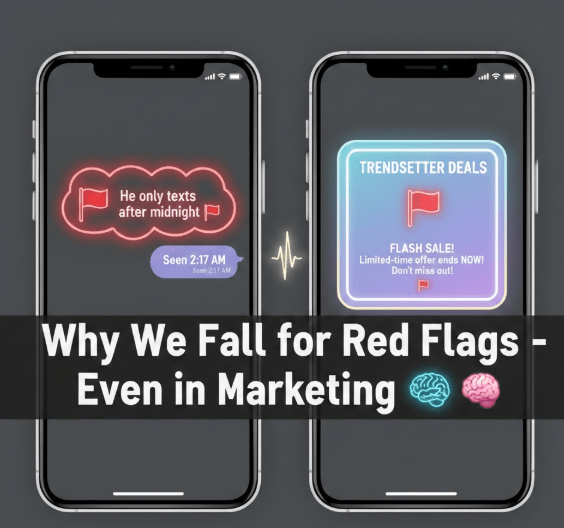
Red flags feel good for a reason. Psychology explains it. Marketing profits from it.
Welcome back to Raw Real Hrit – where we make chaos make sense. ✨
🎢 Red Flags = Thrill. Green Flags = Peace. Guess Which One Trends?
Your brain secretly LOVES unpredictability.
Peace feels calm 😌
But chaos? Chaos feels like an adrenaline shot. ⚡
That’s variable reward theory – the same reason you:
- refresh Insta for no reason 📱
- check messages from someone who never texts first 😭
- fall for the “maybe this time” illusion 💭
- get hooked on TikTok’s random surprises 🎁
Red flags activate the same dopamine loop as:
- slot machines 🎰
- sudden discount codes 💸
- algorithm rewards ⚙️
- push notifications that appear right when you’re lonely 😮💨
Your ex and your favourite app? Same formula. Different packaging.
🎭 Drama Goes Viral. Stability… Doesn’t.
Nobody sends screenshots of healthy conversations.
But one toxic paragraph?
HELLO – all the friend groups are notified immediately. 📩👀
Brands know this too.
So they lean into:
- chaotic copywriting ✍️
- unhinged campaigns 😂
- relatable heartbreak memes 💔
- “this could’ve been your ex” aesthetics 🥲
- bold personality branding 🎨
Drama gets comments.
Drama gets shares.
Drama gets engagement.
Stability gets… seen and ignored. 👋😶
✨ Red Flags Have Aesthetic. Green Flags Have… Normalcy.
Think about it:
“My partner is kind and emotionally mature.”
– cute, but no one reacts.
“I fell for someone who communicates like he’s on a data plan from 2005 but damn he’s pretty.”
– GIRL SAME 😭🔥💀
Red flags are relatable.
They’re messy.
They’re meme-able.
They’re content. 🎬
Brands copy this vibe too:
- mysterious teasers 👤
- morally grey brand personalities ⚫
- situationship-coded marketing 👀
- “you can fix us” campaigns 🛠️
- bold, chaotic storytelling 🌪️
They’ve turned toxicity into strategy – and packaged it aesthetically.
🧠 It’s Actually Psychology (Not Your Fault)
Here’s the messy brain science:
1. Familiarity Bias 🤝
If you grew up around chaos, calm feels suspicious.
2. Scarcity Bias ⏳
Red flags feel like limited-edition attention.
3. Narrative Bias 📖
Your brain LIVES for plot twists.
Green flags give no storyline.
Red flags give seasonal drama.
Marketers exploit these by creating:
- FOMO drops 🔔
- “Waitlist only” energy 📝
- cliffhanger content 🎬
- mysterious brand voices 🌫️
Everything you fall for in people…
you also fall for in products.
💥 So Why Does Gen Z Prefer Red Flags?
Because red flags give:
✨ excitement
✨ risk
✨ intensity
✨ chaos
✨ a story
✨ a personality
✨ emotional highs
Green flags give:
🌿 peace
🌿 safety
🌿 predictability
🌿 stability
…and peace doesn’t go trending on TikTok.
(Not yet 😌)
💡 Raw Real Hrit Takeaway
People, brands, influencers, algorithms – they’re ALL using the same formula:
Give them chaos – keep them hooked.
Give them little hope – keep them coming back.
But once you see through the psychology, you stop mistaking red flags for butterflies. 🦋
(Or at least… you hesitate for 0.4 seconds.)
💬 Spill the Tea
What’s the most unhinged red flag YOU ever fell for – in a person or a brand?
Drop it below 👇🤭
I might turn the craziest ones into Blog 22.
 Raw. Real. Hrit.
so true!
LikeLike
hahaha
LikeLike
I’ll always choose green please 🙏🏻 much safer and happier
LikeLike
i couldn’t agree more ❤
LikeLike